Bullet Journaling for Genealogy
Bullet Journaling
is a flexible planning and organizational method that combines a calendar, to-do list, notebook, and journal in a single system. Rather than using a pre-printed planner, individuals create their own structure using simple symbols (called “bullets”) to track tasks, events, notes, and goals. The system can be as minimalist or as creative as the user prefers.
For genealogists and researchers, Bullet Journaling can be used to track research projects, maintain research logs, record ideas, plan tasks, monitor progress, and capture future research questions in a single, customizable notebook.
A PDF version of this post is available here.
ORIGINS
Bullet Journaling was developed by Ryder Carroll, a digital product designer from the United States. Carroll developed the Bullet Journal method over many years while trying to manage the challenges of ADHD. As a child and teenager he struggled with distraction and information overload, both of which led to a heightened experience of dis-organization. He began experimenting with ways to capture information quickly and create external systems that reduced the mental effort required to manage the information and tasks that overwhelmed him. By college, he had refined many of the practices that later became the Bullet Journal.
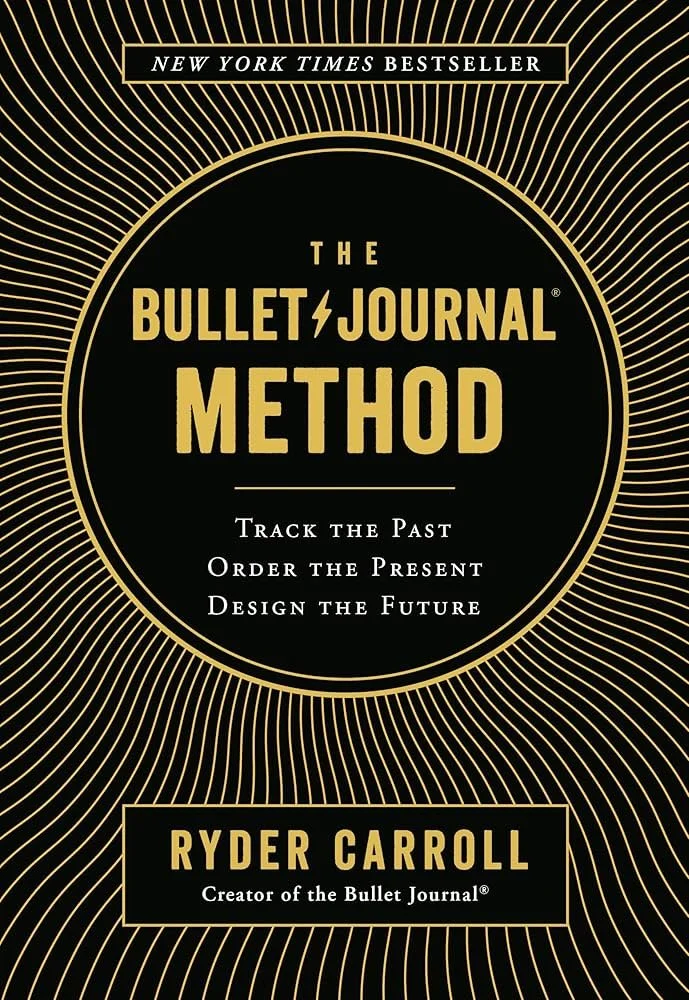
In 2013 Carroll introduced his system publicly through the Bullet Journal website and online videos. The method gained widespread popularity because it is highly adaptable and can be tailored to the individual needs of the user. In 2018, he published his book on the method in which he emphasized:
“The Bullet Journal method’s mission is to help us become mindful about how we spend our two most valuable resources in life: our time and our energy.”
Several themes appear repeatedly in Carroll’s interviews:
A notebook serves as an external memory
Writing by hand forces you to be intentional
Not everything that captures our attention deserves our time and energy
Productivity should support a meaningful life rather than becoming an end in itself
Reflection is as important as planning
Carroll often describes bullet journaling as tracking the past, organizing the present, and planning the future (which he presents as the subtitle of his book). These three aspects of the method are achieved through the core concepts of the system.
THE CORE CONCEPTS
The Bullet Journal method is built around a few core components:
Rapid logging – capturing information quickly using symbols and short entries
Collections – themed pages devoted to specific topics, projects, or lists
Migration – regularly reviewing and transferring unfinished tasks to determine whether they remain worthwhile
Daily, monthly, and future logs – planning tools that help organize tasks and commitments across different time frames
RAPID LOGGING is the foundation of the entire system. It captures information before it is forgotten. It reduces mental clutter and encourages concise thinking. Instead of writing long paragraphs, information is captured as brief entries using symbols (“bullets”) and short phrases. Carroll’s goal was to overcome the point of resistance between having a thought and recording it. Common bullets include:
• Task
○ Event
– Note
Additional signifiers can be added in front of a bullet to help them stand out from the rest of the list and highlight characteristics of the bulleted item, such as priority, inspiration, follow-up, etc.
One of the strongest elements of the method is the simple process of creating an index for the journal (and across journals when one is full and a new one started) that turns each notebook into a searchable record.
Uses for genealogists
Rapid Logging can be used to capture many elements of our research, all in one place, including:
Research notes
Research logs
To-do lists
Correspondence tracking
Conference notes
COLLECTIONS are one of the most flexible aspects of the system. A collection is any group of related information and might include:
Books to read
Travel planning
Household projects
Health tracking
Collections allow users to build project-specific workspaces within the notebook that keep related information together, thus avoiding the experience of scattered notes across multiple notebooks. Carroll’s philosophy is that the notebook becomes a single trusted location for thinking and planning.
Uses for genealogists
Genealogy research questions
DNA match analysis
Conference notes
MIGRATION is a distinctive feature of the Bullet Journal, supporting our ability to prioritize the endless tasks demanding our time and energy.When a month ends, or when tasks remain unfinished, instead of endlessly copying tasks forward, the user reviews them and consciously decides:
Do it
Schedule it
Move it
Eliminate it
The repeated rewriting of tasks acts as an intentional obstacle to disrupt the never-ending additions to our to-do list. Its purpose is mindful evaluation of our to-dos, the idea being that if you keep rewriting the same task month after month, you will eventually ask yourself whether that task is actually important to you. Migration acts as a filtering system that helps you evaluate whether you really want to prioritize a task or drop it from your to-dos.
Uses for genealogists
As researchers, we often find ourselves growing our list of ideas and tasks that we would like to follow-up on someday, such as:
Future research ideas
Bright Shiny Objects (aka BSOs)
Conference follow-ups
Education plans
However, not all these to-dos retain the urgency we feel when they first capture our attention. Migrating our list over time allows us to re-evaluate an item’s place on the list and gives us the freedom to choose whether we really want to invest our valuable time and energy on that item.
THE DAILY LOG is what Carroll describes as the workhorse of the Bullet Journal because it captures the daily deluge in real time. New entries are added as the day unfolds:
Tasks
Notes
Observations
Appointments
Ideas
Unlike traditional planners, space is not pre-allocated. You simply continue writing until the day is finished. The daily log is more than a simple to-do list, capturing your responsibilities. It also helps you document experiences. This flexibility of format and the content it captures, is part of the reason many users prefer the Bullet Journal to commercial planners.
THE MONTHLY LOG provides a high-level overview of the current month. It bridges long-term planning and day-to-day activity, giving you an opportunity to take a step back and look at all the things you have to-do, as well as your available time. Traditionally it includes:
Calendar dates
Appointments
Important events
Monthly task list
Uses for genealogists
Archive visits
Research goals
Consultation appointments
Article writing deadlines
Presentation preparation
Webinars to attend
THE FUTURE LOG captures commitments that have specific dates beyond the current month. When the relevant month arrives, items are migrated into the Monthly Log. Think of it as a place for things you don’t want to forget, but you don’t need to act on them yet. Typical examples include:
Conferences
Appointments
Travel
Deadlines
Long-term goals
Carroll describes the Future Log as a queue, waiting for its month to arrive. When you set up a new Monthly Log at the start of each month, you scan the Future Log and migrate relevant items out of the Future Log and into that new month. You then mark the item in the Future Log as migrated, so you know you have dealt with it and no longer need to think about it.
REFLECTION is one of the themes that appears repeatedly in Carroll’s writing and interviews. The Bullet Journal method was designed as a mindfulness practice as much as a productivity system. While many online descriptions focus on the layouts and trackers, Carroll often emphasizes:
Morning reflection
Evening reflection
Intentional review
Evaluating where we use our time and energy
Uses for genealogists
The reflection component of the system is one of the more interesting aspects for genealogists because it resembles:
Evaluating research progress
Reviewing evidence
Determining next steps
Deciding what research deserves our continued attention
The system adapts itself well to the needs of the family researcher. The journal can be used as a place to evaluate our research tasks and decide which ones warrant our time, while also making it easier to integrate those tasks with the other responsibilities in our lives.
---
WEBSITES AND RESOURCES SHOWING REAL-WORLD USE
Official Resources
Bullet Journal Official Website
Ryder Carroll Biography
What is Rapid Logging?
Future Log Guide
https://bulletjournal.com/blogs/faq/how-to-make-a-future-log
RYDER CARROLL VIDEOS
How to Bullet Journal (Official Introduction) [4:11mins]
https://www.youtube.com/watch?v=fm15cmYU0IM
The best place to begin because it explains the original method directly from Carroll
How to Declutter Your Mind – Keep a Journal (TEDxYale – 20 January 2017) [12:50mins]
https://www.youtube.com/watch?v=ym6OYelD5fA
Focuses more on thinking, attention, and intentionality than planning
How to Work with ADHD (Ryder Carroll & Nir Eyal 10 July 2025) [16:22mins]
https://www.youtube.com/watch?v=KuhQT4Xc8ys
ADHD and Bullet Journal – A conversation between two high achieving, NYT bestselling authors and how they have learned to thrive in life with an ADHD diagnosis
COMMUNITY EXAMPLES
Minimalist / Functional
Basic Bullet Journals Reddit Community
https://www.reddit.com/r/BasicBulletJournals/
Particularly useful because users emphasize functionality over artistic decoration.
Creative / Decorative
Bullet Journal Reddit Community
https://www.reddit.com/r/bulletjournal/
Shows a wide range of artistic interpretations.
Beginner-Friendly Examples
Tiny Ray of Sunshine Bullet Journal Guide
https://www.tinyrayofsunshine.com/blog/bullet-journal-guide
One of the classic explanatory guides that many users cite when learning the method.
ADDITIONAL RESOURCES
A 10-Minute Notebook Setup You'll Actually Use [6:21mins]
https://www.youtube.com/watch?v=DjEZM4RqaeY
Bullet Journal in 5 Minutes a Day (for busy people) [4:16mins]
https://www.youtube.com/watch?v=T_Op4hrLSc4
What You're Missing: A Notebook System for Your Life [8:07mins]
https://www.youtube.com/watch?v=RVTplS-WwsA
Top Beginner Notebook Mistakes! [15:23mins]
https://www.youtube.com/watch?v=kV8Kdb0miYA
3 Simple Ways To Be More Consistent In Your Life [9:08mins]
https://www.youtube.com/watch?v=liLPA2PqlOM&list=PL_0Xw2SKMUVXHtSIKIxdK8xNxkrszk-bE&index=16
How To Be Ready For The Whole Year [6:54mins]
https://www.youtube.com/watch?v=RlJpSXTqNF0&list=PL_0Xw2SKMUVXHtSIKIxdK8xNxkrszk-bE&index=17
Give Me 11 Minutes and I'll Change Your Notebooks Forever [10:58mins]
https://www.youtube.com/watch?v=uDCntmS89YE
Using a Notebook (This Way) Still Beats Every Productivity App [16:16mins]