Evaluating Permanent.org for Genealogy Archives
Many genealogists are searching for ways to preserve family photographs and documents for future generations. A student in my Organizing for Genealogy course recently asked whether the platform Permanent.org might be a useful solution. She had encountered the platform through a short video presented at this year’s RootsTech conference.[1] Before adopting any new tool, it is helpful to understand how it works, what role it plays in a digital preservation system, and whether it fits within a genealogical workflow.
Understanding this role helps clarify when the platform may be useful and when other tools may be more appropriate.
What is Permanent.org?
Permanent.org is a digital archiving platform designed to allow individuals, families, and small organizations to create long-term digital archives of photos, documents, videos, and other files. These archives can be kept private, shared with family members, or made publicly accessible.
Operated by the Permanent Legacy Foundation, Permanent is a U.S. 501(c)(3) nonprofit cultural heritage organization whose stated mission is to preserve digital legacies for future generations.[2] The organization presents itself as a stable nonprofit alternative to commercial cloud storage services. Unlike typical cloud services designed primarily for storage and synchronization, the platform is intended to function as a curated personal archive with sharing, legacy planning, and preservation features.[3]
KEY FEATURES
Permanent.org combines several functions relevant to genealogists and family historians:
Digital archive creation
Controlled sharing
Legacy planning
Collaboration
Digital archive creation
Users can upload and organize photos, videos, documents, and audio files.[4]
Controlled sharing
These materials can be kept private, shared with selected individuals, or made public.[5] The platform includes:
Permission-controlled sharing
Public or private collections
Time-limited or restricted links[6]
Legacy planning
Permanent includes features intended for digital estate management, such as:
Designating an Archive Steward
Assigning a Legacy Contact who receives access after death
This feature is explicitly designed for long-term family history preservation.[7]
Collaboration
Archives can be shared and collaboratively edited with family members or organizations.[8]
PRESERVATION MODEL
One of the main characteristics of Permanent.org is its funding and storage model.
One-time storage purchase
Instead of subscriptions, users pay a one-time fee for storage space (e.g., about $10 per GB). The fee goes into a nonprofit endowment intended to fund ongoing storage costs indefinitely. The model could be described as similar to a cemetery plot:
Pay once
Storage is intended to persist indefinitely
Multi-cloud redundancy
The platform stores files across multiple cloud providers, maintaining redundant copies to reduce the risk of data loss.[9]
Format migration
Permanent also maintains files in open formats and migrates formats when necessary to avoid technological obsolescence.[10]
ADDITIONAL SERVICES
Permanent also offers services beyond storage, such as digitization services and education programs.
Digitization services
The organization provides paid services to:
Scan photos
Add metadata
Organize collections
Produce photo books or mini documentaries[11]
Educational programs
They run training programs such as Legacy Lab, which teaches people how to build personal digital archives.[12]
ROLE IN A DIGITAL PRESERVATION SYSTEM
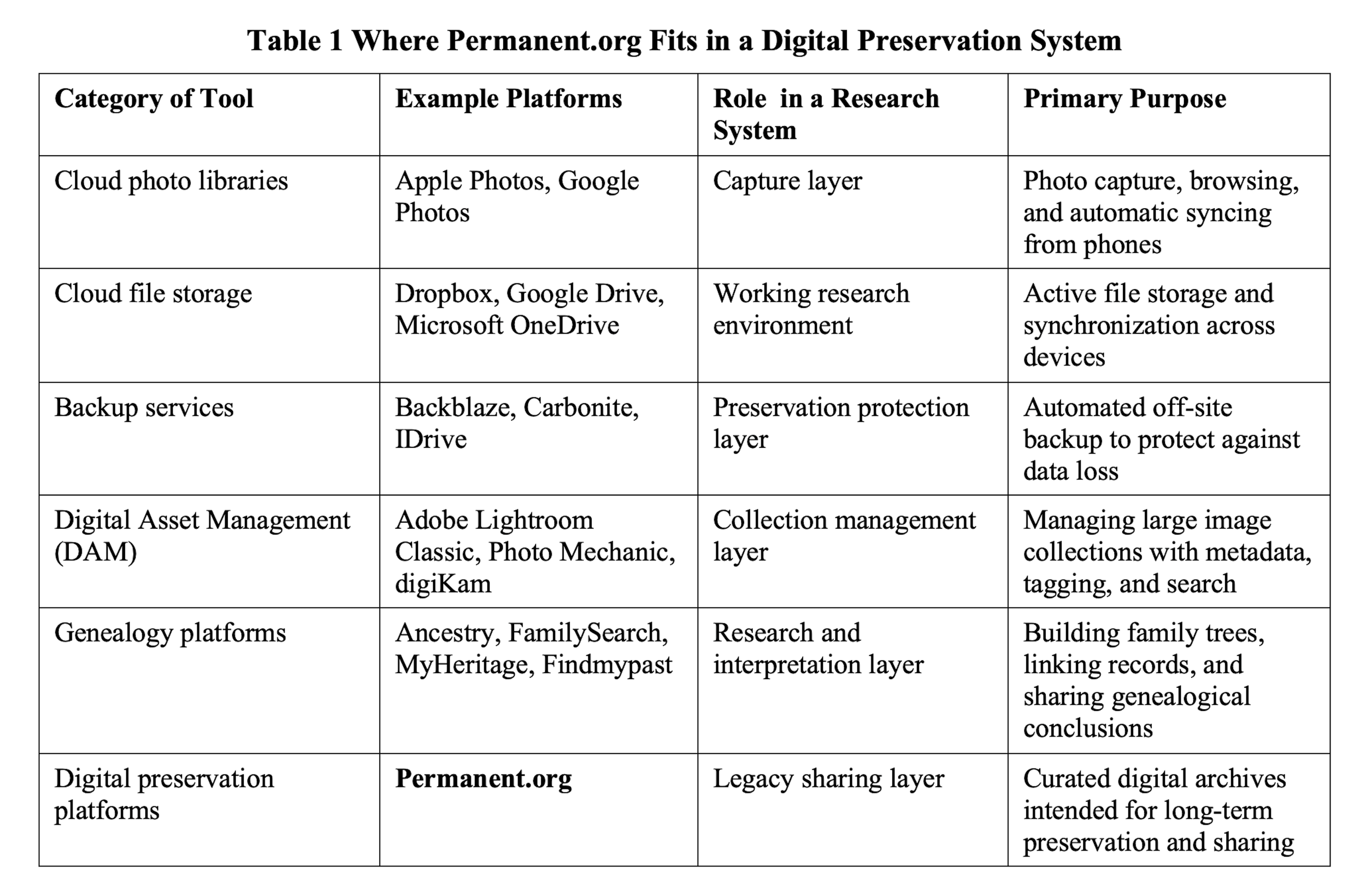
Permanent’s goal is to apply archival practices used by museums and libraries to personal digital collections. In traditional archives, materials are selected, organized, described, and preserved so they can be understood and accessed in the future. Rather than functioning primarily as a storage or photo management tool, the platform is designed to apply these principles—curation, contextual description, and long-term stewardship—to personal digital archives. In this model, the emphasis is on preserving selected materials with meaningful context rather than managing large working collections of images or research files.
The following table (Table 1) illustrates where Permanent.org fits relative to other commonly used tools in a digital preservation system.
STRENGTHS
Permanent.org’s digital archive platform has a number of potential advantages for genealogists:
Nonprofit mission rather than profit-driven
Long-term preservation model
Legacy transfer planning
Private or public archive creation
Collaborative family archiving
Emphasis on metadata and storytelling
POTENTIAL LIMITATIONS
From a research perspective, there are several issues that should be evaluated carefully:
Platform dependence and longevity consideration
Storage cost
Archival focus rather than day-to-day photo management
Platform dependence
Like any hosted platform, your archive ultimately depends on the organization’s survival. Although the service aims for permanence, no digital platform can truly guarantee that outcome. The platform uses an endowment-based financial model to support long-term digital preservation.[13] One-time storage fees contribute to a pooled endowment and investment income is intended to fund ongoing storage and operational costs. The model assumes that investment returns from the endowment will continue to support these costs. However, while this is a laudable framework, there is no guarantee that this will ensure the organization’s survival for future generations to access.
Storage cost
While the cost per gigabyte sounds modest ($10), users should recognize that digital images and files can accumulate quickly. One GB accommodates about 125-500 photos (assuming photos are between 2MB and 8MB in size). For genealogists working with large photo collections and other files they may wish to upload, total storage costs increase quickly. The model is therefore best suited to curated collections, which they do emphasize, rather than comprehensive research archives.
Archival focus rather than day-today photo management
Permanent is designed as an archival platform for curated collections rather than as a working photo management system. During active research, genealogists typically need tools that support rapid file handling, sorting, editing, and batch organization. Permanent’s strengths lie in preserving selected materials and presenting them with descriptive context rather than managing large volumes of working research images.
FINAL ASSESSMENT
Permanent.org is best understood as a digital legacy archive, not a working research or storage system. For genealogists it may be most appropriate as a long-term public or family archive of curated materials and a digital estate archive for future generations.
After taking a closer look at the platform, like my student, I too found it interesting. I am a strong proponent of treating our genealogical material as our personal archive. I value curation to ensure the best use of our resources (time, energy, money) to preserve what is most important to us. Without curation we can become overwhelmed by all the incoming information and material that is part of researching family history. A tool that encourages us to assess our material and decide what is important enough to archive and preserve is very compelling. The ability to keep the archive private or make it public, or share links to content with select individuals, fills a need that exists for many researchers: how to best share our work with others, both now and for future generations.
The question for me is “would this tool serve me now?” My current priorities do not include learning a new system to archive and share with others. I have a short list of projects for this year. I carefully chose those projects because they are important to me, and I want to complete them. While the results of using Platform.org may prove valuable to me, I don’t wish to divert my current resources from my current priorities.
I have a very stable organization system for my research materials. This is the result of several years of planning, execution, evaluation, and adjustment. One of my priorities this year is to start building a comparable system for my photos. I have a plan and I’m currently working on it:
Consolidate all my photos in one platform and refine my back up protocol for the collection
Separate my photos into categories such as personal family photos, historical photos, genealogical research, and projects
Curate the collection and cull unimportant images
Create a finding aid for the collection
I currently share with my family in various ways that are working, so there is no rush to suddenly adopt a new system. I have two private family Facebook groups, one each for my maternal and paternal lines. I chose that platform deliberately and it currently suffices for my sharing needs. My siblings and cousins can access the material I post, and my cousins show posts to their parents who cannot easily navigate any digital system for sharing.
I do admire the idea of Permanent.orgs’s endowment model, which works for universities and museums. Their partnership with FamilySearch is another attractive point for me because I respect FamilySearch’s mission of making genealogical research freely available online and preserving it for future generations to access.
However, when I have a stable photo collection, ready for the next step of legacy preparation, I will take the time to assess options as I plan the next steps for my collection. I will consider if a tool like Permanent.org would add enough benefit to warrant my time, energy, and money.
Before making a choice about adding another platform to incorporate, my priority is a stable, organized, safely backed-up digital photo collection.
[1]https://www.familysearch.org/en/rootstech/session/how-to-build-your-digital-archive-on-permanent-org
[2]https://www.permanent.org/about-us/
[3]https://familylocket.com/curating-and-preserving-personal-digital-archives-with-the-permanent-legacy-foundation/
[4]https://permanent.zohodesk.com/portal/en/kb/articles/file-types-that-we-accept-and-support
[6]https://www.permanent.org/blog/share-with-confidence/
[7]https://permanent.org/blog/legacy-planning-is-here/
[8]https://thephotomanagers.com/preserving-digital-legacies-for-generations-the-power-of-permanent.org
[9]https://permanent.zohodesk.com/portal/en/kb/articles/redundant-backups
[10]https://permanent.zohodesk.com/portal/en/kb/articles/format-conversion
[11]https://www.permanent.org/preservation-services/
[12]https://www.permanent.org/legacy-lab/
[13]https://www.permanent.org/wp-content/uploads/2019/05/Permanent-Legacy-Foundation-Manifesto-v2018-10-05.pdf p7